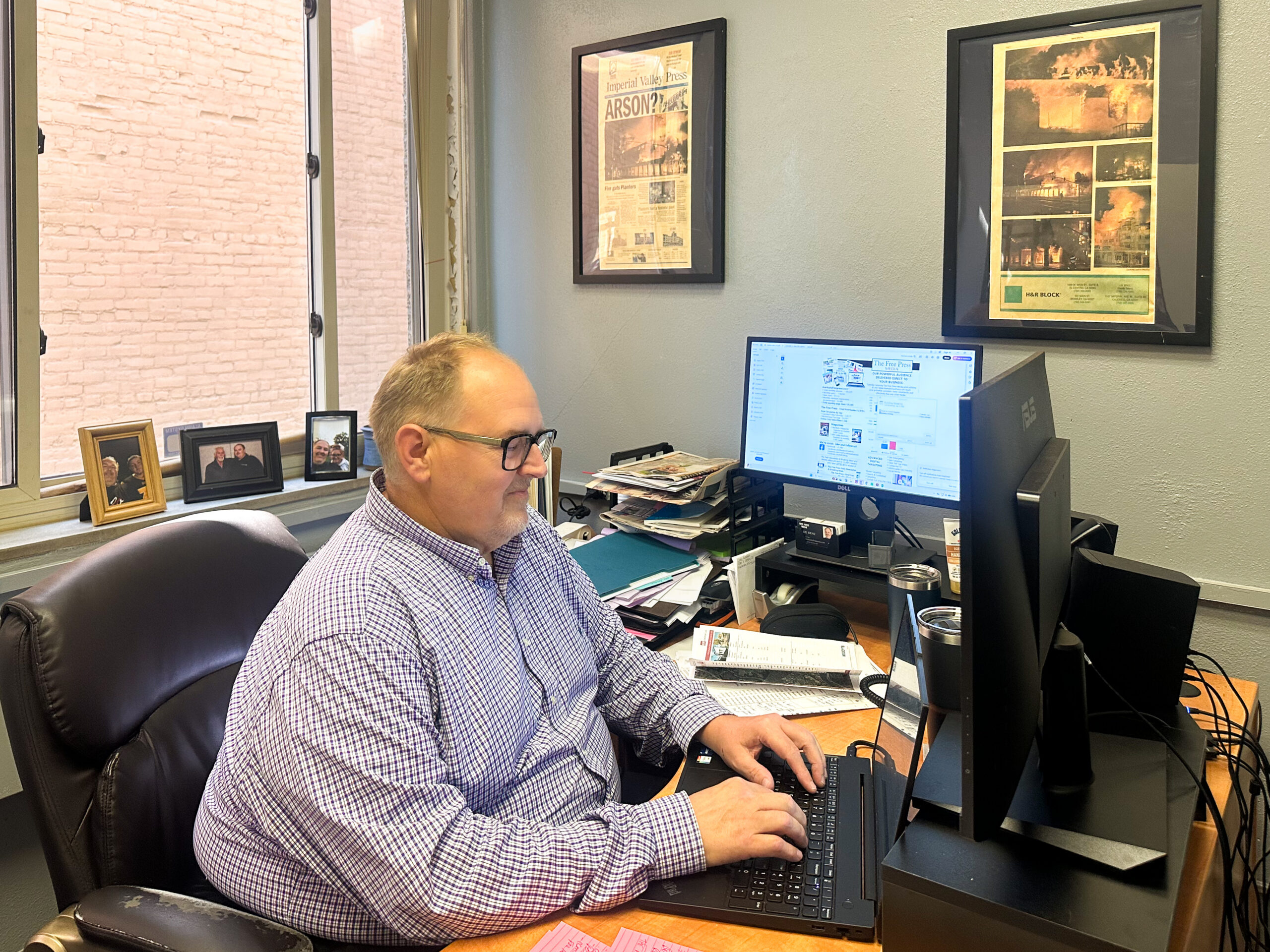


New Mankato Free Press Publisher Todd Benz is stepping into his role leading a legacy, local institution at a moment when the newspaper is visibly changing. His focus is on transforming a 144-year old community staple while preserving its mission of trusted, local journalism.
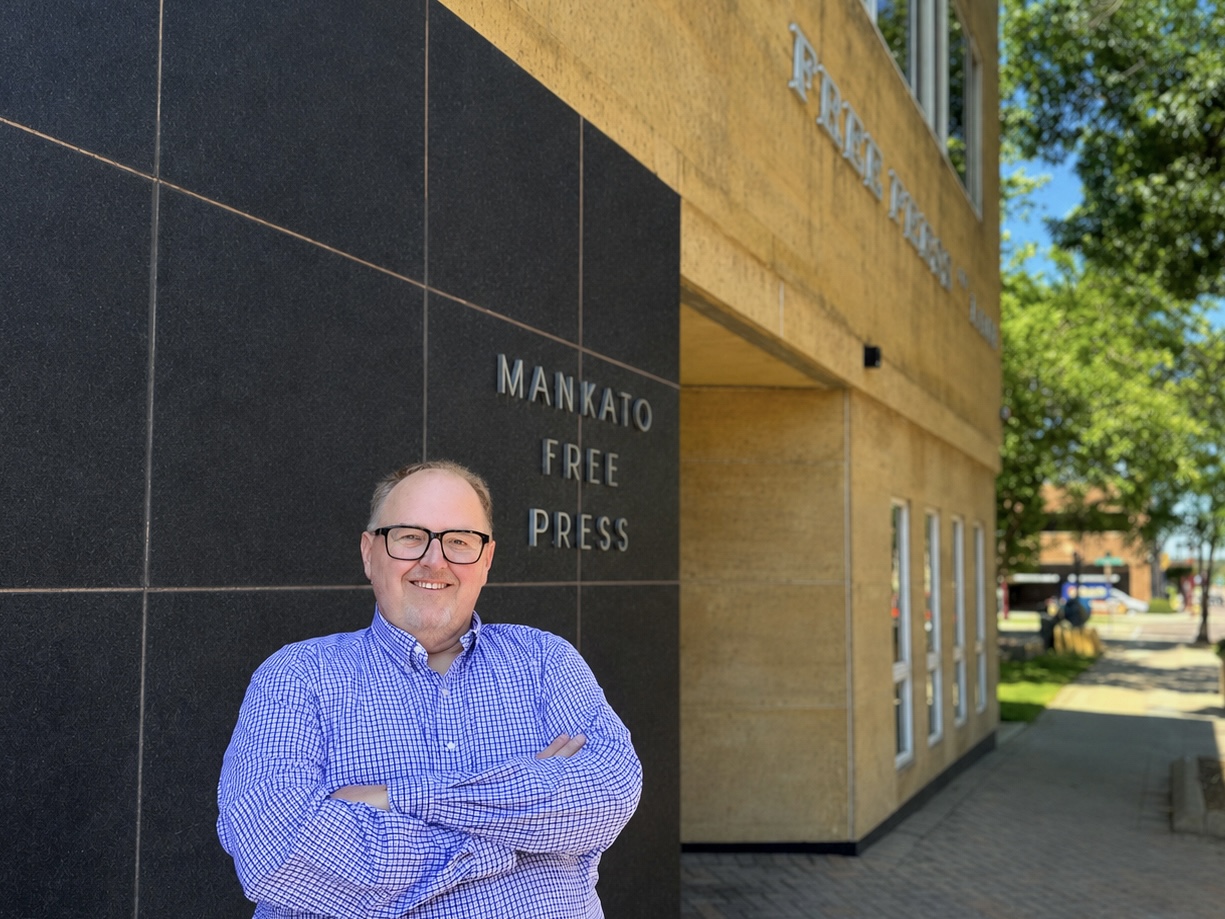
Todd Benz outside The Mankato Free Press building.
Photos by Molly Byron
Todd Benz’s first job in the newspaper business came at 12 years old. He had a paper route for the Milwaukee Sentinel. Six days a week he delivered papers, later collected subscription payments and began to learn the business that would eventually define his career.
He recalls a retirement home, where he delivered the paper at each door and would visit with residents. It wasn’t uncommon to pick up $1.35 in coins set in a tea cup by an elderly resident for that week’s subscription.
Those days are long gone, as both the world and newspaper industry have undergone profound change. For Benz, who now serves as publisher of The Mankato Free Press, the work is still grounded in relationships, community and trust.
“They say once the ink gets in your blood, it’s hard to get out,” Benz commented. “And that’s the truth.”
For the past four decades, Benz has been leading publications within the newspaper industry. His path has taken him from Wisconsin to California, South Carolina, North Carolina, Florida, Iowa, Ohio and now Mankato. He’s worked in circulation, distribution, sales, marketing, operations, advertising and publishing. He’s managed mailrooms, carriers, sales teams, press operations, digital growth and regional newspaper groups.
This breadth of experience matters in an industry facing large-scale business transformation initiatives, where the old playbook no longer applies. It’s about reinventing the business around a mission that still matters.
“One of the things that we do better than anyone is produce quality local journalism,” he says. “That is first and foremost what our mission is. No one else can do it.”
Small-town roots, national perspective
Benz grew up in Cedarburg, Wisconsin, just north of Milwaukee. He describes it as a small town, about 7,000 people with a strong sense of history and place.
He grew up in a small family with one brother, later expanding to include a stepbrother and stepsister, and as a Wisconsin native, he’s naturally a Green Bay Packers fan and self‑proclaimed “cheesehead.
After working part time through high school at the Milwaukee papers, Benz started full time the day after graduation as a district manager. Back then, the Milwaukee market still had two daily papers, the morning Sentinel and afternoon Journal. The work was physical, local and hands-on. Sunday papers were assembled by hand.
“It was a way different world back then,” Benz says.
From Milwaukee, he moved to Conley Publishing in West Bend, Wisconsin, where he started as mailroom manager and eventually moved into circulation. He later joined Gannett in north central Wisconsin, beginning with the Stevens Point Journal before becoming regional sales and marketing director for a cluster of papers.
Then came a major geographic leap when Benz moved from Wisconsin to El Centro, California, near the Mexican border to join Schurz Communications.
“It was a huge transition, but it was good because I learned a lot there,” he says.
The role expanded his view of the business. He started as circulation director, then took on the mailroom, pressroom and broader operational responsibilities. He also became more involved in advertising.
That pattern repeated throughout his career. In Anderson, South Carolina, with the E.W. Scripps Company, he again started in circulation and moved closer to advertising and content. He even took over a quarterly lifestyle magazine, helping choose stories, write articles and take photos.
In Burlington, North Carolina, he added more production and advertising experience. In Bradenton, Florida, with McClatchy, he became a director of audience development, working with multiple publications and markets as large as Miami.
His goal, however, was to become a general manager or publisher. That opportunity came in Asheboro, North Carolina, when a former boss called with an opening. Benz accepted.
“I went back to North Carolina, but in the role that I really wanted,” he says, as publisher.
Additional moves followed to Janesville, Wisconsin, with Adams Publishing Group; Lima, Ohio, as publisher; and Dubuque, Iowa, with Woodward Communications, where he focused on sales.
His resume is long, but the theme is consistent. Benz has spent his career learning newspapers from every angle.
Side Bar: The Free Press by The Numbers
Mankato Free Press print circulation: Approx. 6,000 copies per day
Circulation dates: Tuesday through Saturday
Online subscribers: 1,500 per day
Social Media followers: 35,100 people
Daily News and Breaking News goes to more than 13,200 people.
The Free Press website averages 118,000 unique monthly visitors and more than 725,500 monthly page views
Employees: 28
Independent contractors: 65
Entering Mankato at a moment of change
Benz arrived in Mankato a couple months ago. Before interviewing, Benz knew little about Mankato, but what he found has impressed him.
“You don’t get to see many communities today that have the amount of growth happening like Mankato has,” he says. “To see the revitalization of the downtown, along with the outskirts expanding is really cool. And with the vibe of being a college town, that always excites me.”
He is still learning the region. He has been surprised by the traffic, the scale of growth, the housing market and the number of distinct neighborhoods and communities that make up the area.
“It really has that Midwestern friendliness,” Benz says. “People say hello when you walk in the door.”
As he settles into his new role, Benz aims to understand the community, learn the direction of the city and region, the priorities of civic and business leaders, and the needs of residents.
“I need to understand the direction that the city is going in,” he says. “What’s important to our leaders? What’s important to the city? What are their projects? What are they trying to do? But then I also think it’s important to understand what the community wants.”
The distinction between what leaders are working toward and what residents experience every day is central to how Benz sees the role of a local newspaper.
A different kind of publisher
The image of the old-school newspaper publisher who sits behind a closed door office is not the one Benz is trying to recreate.
Benz says today’s publisher has to be visible, accessible and involved. They also have to be willing to do whatever needs to be done.
He describes himself as civic and community minded, a quality he believes is essential for employees of a local newspaper.
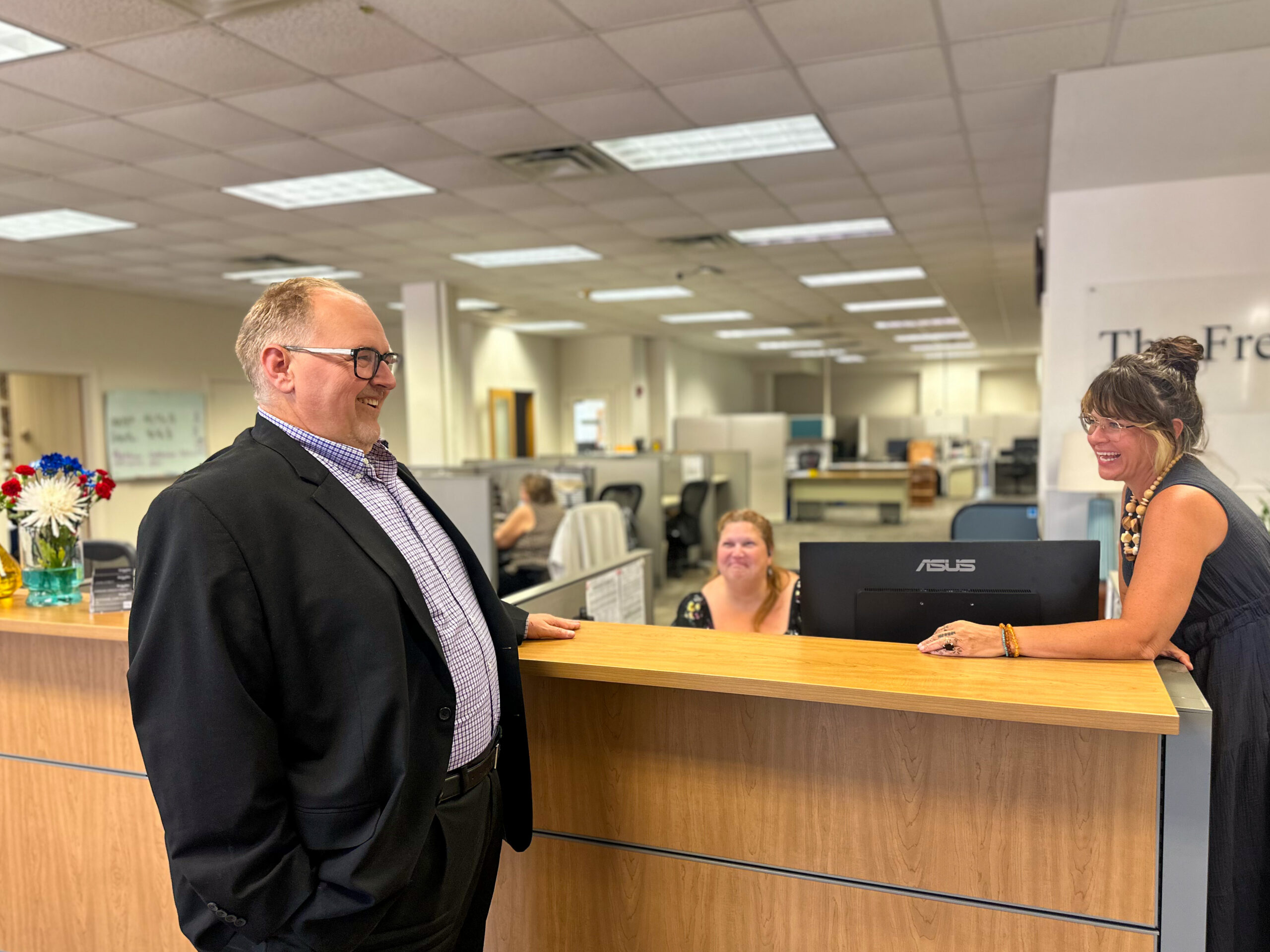
(Left to right: Todd Benz – Publisher, Melanie Biehl – Office Manager, Jordan Greer-Friesz – Advertising Director)
“We have a duty, as employees of the local newspaper, to be involved in the communities that we serve,” he says. “It’s how we develop relationships and learn what the community wants and what the community needs. And sometimes those can be two very different things.”
That involvement informs the journalism, the advertising strategy and the newspaper’s broader relevance. The community, he says, “should feel invested in The Free Press.”
“To me, they’re part of our family,” Benz says. “We want to hear from them when we don’t fulfill their needs. We definitely want to know that. But I also like to hear about the good stuff as well.”
Preserving the mission while changing the model
Benz takes over Free Press at a time when local newspapers across the country are navigating intense economic and operational pressure. Print frequency, production models, staffing levels, advertising trends and reader habits have all changed.
Some of those changes at Free Press were already underway before he arrived. The printed newspaper is no longer delivered seven days a week. The press operation has shifted off site. The business model continues to evolve.
Benz does not minimize the difficulty of those decisions. But he is clear about how he frames them.
“We’re still a seven-day-a-week, 365-day-a-year news gathering organization,” he says. “How we deliver it has changed.”
The printed product is now one part of the operation, not the full definition of it. On days without a print edition, the website continues to be updated with breaking news and information. While this is a shift for readers, it is a necessity for the business.
“I know change is hard for a lot of people, myself included,” Benz says. “If I had my druthers, I would much rather have the press here. I would much rather have a building full of people. But we just can’t make that work.”
He points to the economics of printing as one example. Older presses built only for newspaper production are difficult to sustain. The costs of newsprint, maintenance, labor and facilities have risen sharply.
“The math doesn’t equate,” he says.
That is the reality many business leaders understand. Mature industries require hard decisions. Legacy assets are difficult to maintain and customer expectations are changing. Revenue streams shift and the challenge becomes deciding what to preserve and what must evolve.
For Benz, the filter is the mission.
“Will this decision impact how we produce quality local journalism?” he says. “If not, then let’s focus on what’s important.”
The opportunity ahead
Despite the challenges, Benz is energized about what he sees in Mankato.
“I see tremendous opportunities for The Free Press everywhere I look,” he says. “The hardest part for me is reining in that glee and knowing we can’t do 25 things all at the same time.”
He sees potential in digital growth, newsletters, community engagement, events and new revenue streams that can help support journalism. One example is Best of Mankato, a popular community contest that Benz believes could become even more of a celebration for local businesses, employees and readers.
While digital is central to the opportunities ahead, Benz is careful not to alienate loyal print readers. He too likes holding a newspaper in his hands. That said, he is clear that growth is coming from digital.
“It’s a digital-first mentality that we have to have,” he says. “That’s where our audience has gone.”
Digital allows the newspaper to deliver more from breaking news and multilingual content to puzzles, comics, and greater accessibility than a printed page can provide.
“If you’re not looking at the digital part of our business, you’re missing a lot,” he says.
Trust in an era of journalistic skepticism
Benz also arrives at a time when trust in the media remains a national challenge. He draws a distinction between national media skepticism and the role of a hometown newspaper.
Broad accusations about the media, he says, are often aimed at large national outlets. Local newspapers are different because the people producing the work live in the community.
“We’re the 28 people in this building who are part of the community,” he says. “We work, we go to church, we shop, we’re involved, we go to restaurants, we have a lot of different things going on.”
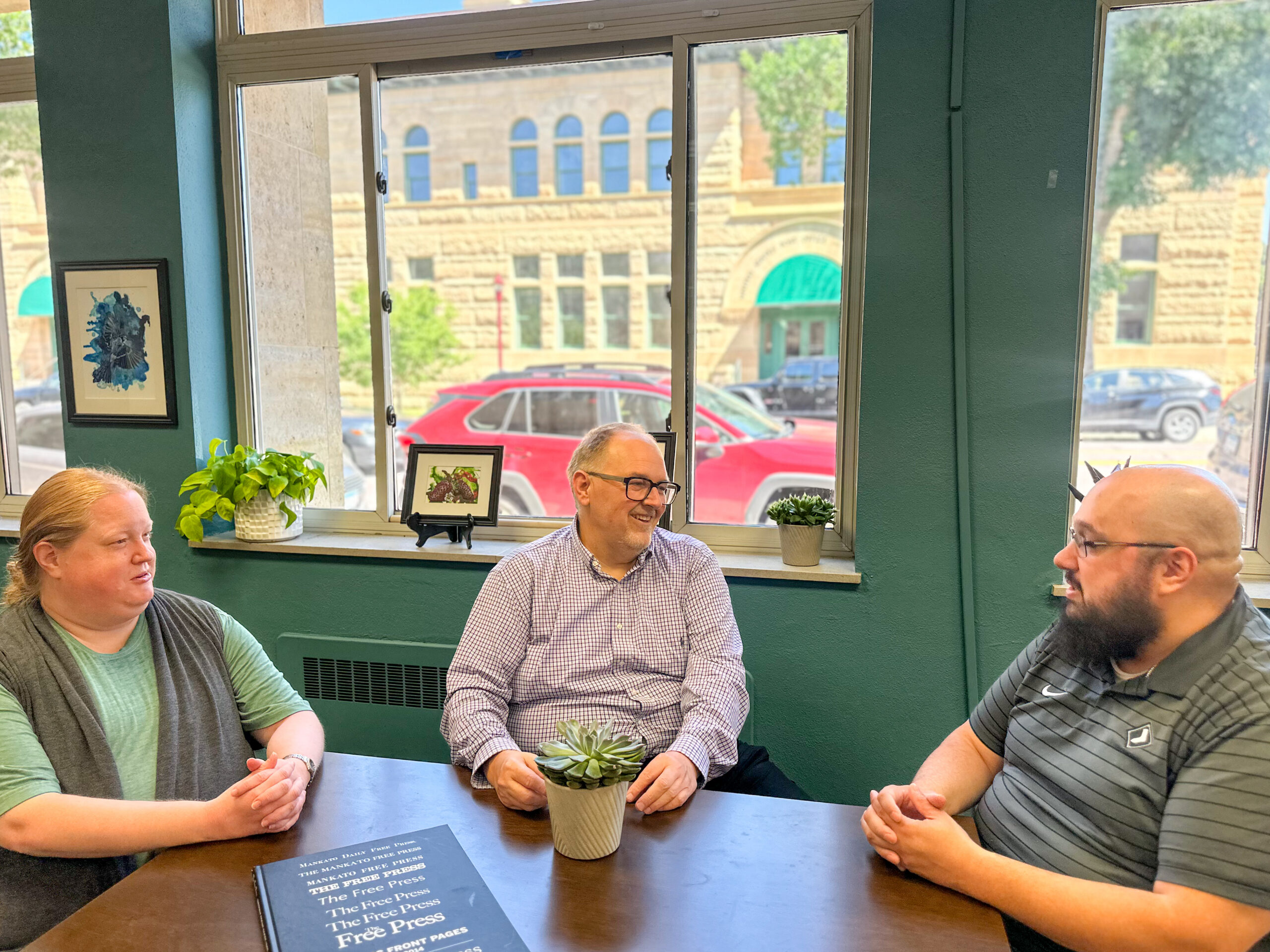
(Left to right: Sharon Toland – Circulation Manager, Todd Benz – Publisher, Michael Petersen -Director of Audience Development.)
Benz believes local newspapers have an important role in telling the deeper story of a community, not just the breaking news, fires, crashes and crime stories.
“I think we need to focus on telling the good story about what’s happening around town,” he says. “The volunteers, the business owners, community builders and the people who are quietly making the region better.”
He also sees a need to examine complex community issues, including homelessness, housing and the lived experience of residents in different parts of the city.
For a newcomer, that curiosity matters. Benz is not claiming to have all the answers yet. He is listening and learning. And, still driving around and getting lost on purpose to understand the community better.
Not dead. Not dying. Not going away.
Ask Benz what he most wants readers to know, and his answer is resolute.
“We are not dead,” he says. “We’re not dying. We’re not going anywhere.”
It is a direct response to a narrative surrounding newspapers today and the reality that roughly two U.S. newspapers close each week, according to Northwestern University’s Medill State of Local News Report. Since the start of the century, that trend has erased nearly one-third of the nation’s newspapers.
Benz’s view is that local journalism remains essential and that The Mankato Free Press has a future if it keeps adapting.
“We’re here for the long haul,” he says. “Are we going to look different today? Yes. Who doesn’t? It’s keeping up with the times and keeping up with the changing media landscape and changing consumer landscape.”
The Free Press recently announced its plan to sell its downtown office building, located at 418 South Second St, and move to a new location, yet to be selected.
“We will continue to provide the best local news, sports coverage and advertising for our communities, just from a different address in Mankato.”
Benz is leading a legacy institution in a time when nostalgia alone will not sustain it. The future will require business discipline, digital innovation, community connection and transparency in explaining why things are changing. It will also require trust.
And for Benz, trust still starts the way it did on that paper route in Cedarburg: showing up, knowing the customer, listening to the community and delivering something people value.
“I’m trying to think about the next 150 years,” he says. “What does that look like, and how can we ensure that The Mankato Free Press is here for that?”